The Beginner's Guide to Using Mala Beads for Mindful Breathing
A mala is one of the most forgiving tools in meditation. It gives your hands something to do, your mind somewhere to rest, and your breath a rhythm to follow. If you have ever sat down to meditate and spent the whole time wondering whether you were doing it properly, a string of beads can quietly solve that. What follows is what a beginner actually needs: which size to buy, how to hold it, what to repeat, and how to count the breath without losing your place.
What a Mala Is, and Why 108 Keeps Appearing
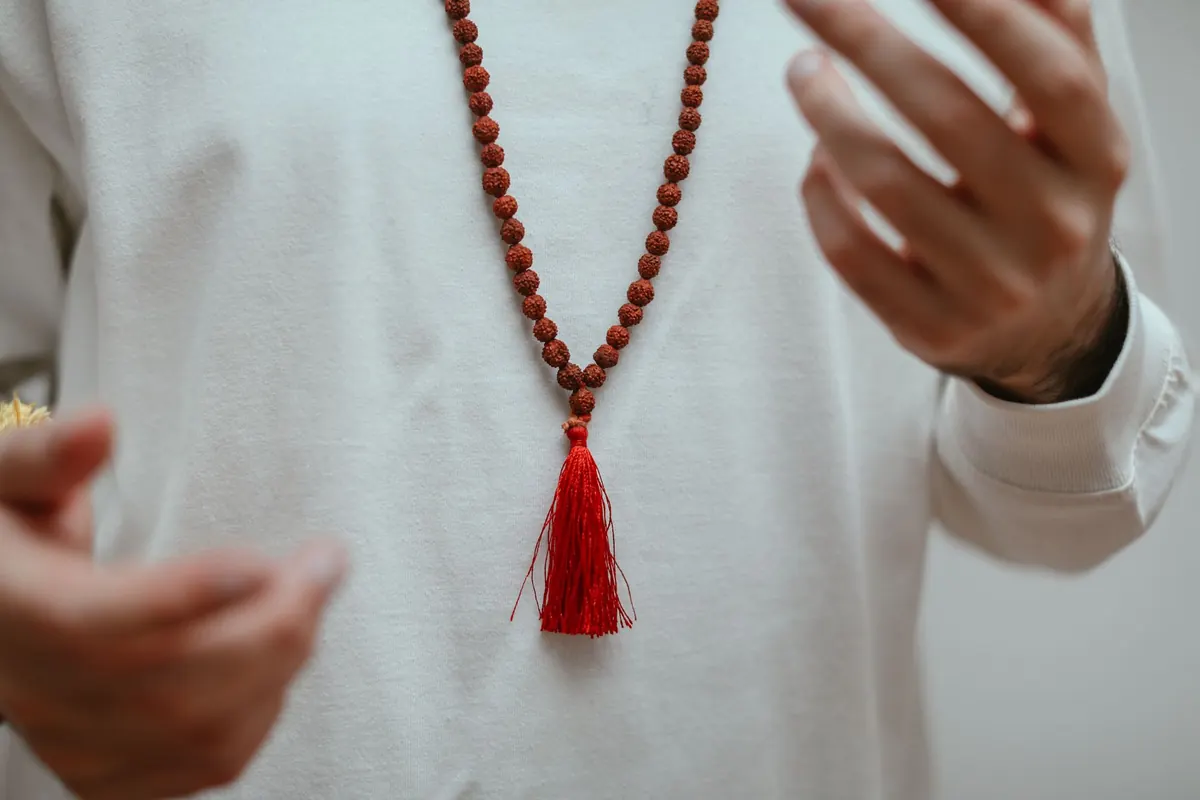
A mala is a string of beads used to keep count during repetition. The word comes from Sanskrit and simply means garland. Most malas hold 108 beads, plus one larger bead called the guru bead, often finished with a tassel. You will also find 27-bead and 54-bead malas, which are fractions of the same count — useful if you want something shorter or small enough to wear.
The guru bead is never counted. It marks the beginning and the end of the strand, a bit like the clasp on a necklace. Between the beads you will often find a small knot of cord, which matters more than it sounds: knots give your thumb something to grip, and they stop the beads sliding past each other too quickly.
Treat the mala as a tally counter for attention rather than a charm. The point is not the object. The point is that your fingers know where you are, so your mind can stop checking.
Choosing Your First Mala
Two things shape how a mala feels in the hand: bead size and material. Everything else is decoration.
Bead size
- 6 mm — fine and light. Comfortable for smaller hands, and a 108-bead strand will often wrap three or four times around an adult wrist, so it doubles as a bracelet.
- 8 mm — the sensible default. Easy to hold, easy to see, and not heavy enough to tire your arm during a longer sit.
- 10 mm — more substantial. A good choice if your grip is weak, your fingers get cold, or you would rather feel the beads than look at them.
- 12 mm and above — heavy and slow-moving. A full strand in this size is long, so it sits best in the lap rather than held up at chest height.
Material and feel
Sandalwood is warm and faintly fragrant, and it dislikes water. Tulsi, rosewood and bodhi seed have a little texture, which helps your thumb find purchase. Gemstone and glass beads are smooth, cool and comparatively heavy, and can become slippery when your hands are dry. If you can, handle a mala before buying it: run your thumb along ten beads and notice whether it feels pleasant or fiddly. You will be doing that movement a great many times.
How to Hold a Mala
Use one hand. Most people use their dominant hand, though either works. Let the loop of beads drape over your middle finger so the strand rests against your palm or hangs loosely below. Your thumb does the work, pushing each bead gently towards you and over the middle finger, so the loop advances bead by bead.
In many traditions the index finger stays extended and clear of the beads. You do not have to take on the symbolism to find it practical — it simply keeps a second finger out of the way. Your ring and little fingers can curl underneath for support.
Rest the hand at the centre of your chest or in your lap, wrist relaxed, elbow heavy. The grip should be light enough that the beads slide and firm enough that they do not tumble. If your thumb aches after ten beads, you are squeezing. Lower the hand if your forearm starts to complain.
When you reach the guru bead, do not step over it. Turn the mala around and travel back the way you came. The reversal keeps the practice continuous rather than restarting it.
Mantra Repetition Without Overthinking It
Choose something short enough to repeat without effort. Widely shared options include Om Mani Padme Hum, Om Shanti, and So Hum, which pairs naturally with the breath. A plain word works just as well — peace, steady, enough — and there is nothing lesser about repeating a phrase in your own language.
One repetition per bead. You can say it aloud, which is steadying when you are sleepy; in a whisper; or silently, which is the subtlest and the easiest to lose. Most beginners do well with a whisper for the first few weeks.
Some traditions hold that certain mantras should be received from a teacher rather than picked up from a book. That is worth respecting. Stick to a widely shared mantra or your own simple word, and you will not go far wrong.
Counting the Breath
This is where the mala earns its keep. Rather than holding a number in your head, you let your thumb hold it for you. Try one of these:
One bead per breath. Inhale as you push one bead forward, exhale as you push the next. A full mala becomes 54 breaths. The counting happens in your fingers, and your attention stays on the air moving in and out.
So Hum. So on the inhale, Hum on the exhale, one bead per complete breath. A full strand is 108 breaths — roughly twenty minutes at a comfortable pace.
A counted breath. Inhale for a count of four, pause for two, exhale for six, moving one bead on each exhale. Many people find a slightly longer exhale more settling than a longer inhale.
Never force the breath. If you feel dizzy, tingly or short of breath, drop the count and breathe normally until it passes.
If you have a heart or lung condition, or you are pregnant, speak to a doctor before starting structured breath practice. General guidance is no substitute for personal medical advice.
A Ten-Minute First Practice
- Sit where you will not be interrupted — a chair with your feet flat, or a cushion with your hips slightly raised. Spine upright, shoulders soft.
- Take the mala in one hand and find the guru bead. Hold it for three easy breaths before you begin.
- Decide on your mantra and your breath pattern now, so you are not choosing mid-practice.
- Move one bead per repetition, working away from the guru bead.
- Aim for 27 beads — a quarter of the strand. This takes a few minutes and is a realistic first target.
- If you reach the guru bead and have time, turn and continue. If not, stop and sit still for a few breaths.
- Rest your hands in your lap, close your eyes, and notice how you feel for a minute before getting up.
Keeping the Practice Going
Keep the mala somewhere you will see it — a bedside table, a shelf by the kettle, a bowl on your desk. Store it out of direct sunlight and away from damp, perfume and oils, since sandalwood, tulsi and some stones mark or dull easily. A small cloth bag is ideal.
Ten minutes most days will do more for you than an hour once a month. Attach the practice to something you already do: after your morning tea, before you check your phone, once the house goes quiet. If you lose track mid-practice, return to the guru bead and start again — the returning is part of the practice, not a failure of it. And if you miss a day, no penance is required. Pick up the beads, find the guru bead, and begin.
Photo: Cup of Couple / Pexels