How to Start a 5-Minute Breath Meditation (Even If You Can't Sit Still)
You do not need a cushion, a candle, or a spare half hour. Five minutes and a pair of lungs will do. Most people who say they cannot meditate have already tried: they sat down, closed their eyes, and within forty seconds they were re-running yesterday's argument or planning tonight's dinner. The mind wandered, they assumed they had failed, and that was that.
Breath meditation works for busy people precisely because it asks so little. It does not require you to empty your mind or sit for an hour. It asks you to notice one breath, then the next, and to come back when you drift. Restlessness is not an obstacle to that. Handled well, it becomes part of the practice.
Why Five Minutes Is Enough to Start
The instinct is to aim high. Thirty minutes sounds like a proper practice, so that is what we promise ourselves on a Sunday evening — and by Wednesday the cushion is somewhere under the bed. A five-minute session is short enough that you will actually do it on a bad day, which is the only day that matters for building a habit.
Consistency does more work than duration here. Five minutes daily for a fortnight will teach you more about your own mind than one heroic forty-minute sit that you never repeat. Short sessions are also repeatable: you can slot one in before a difficult phone call, and another on the train home, without rearranging your day.
There is a practical benefit too. Slowing the breath and letting the exhale run a little longer than the inhale tends to settle the body. You are not chasing a dramatic shift; you are giving your nervous system a brief, clear signal that nothing urgent is happening right now.
Three Decisions Before You Begin
Sort these out once and the practice becomes much easier to keep.
- Where. Pick one spot — a kitchen chair, the edge of the bed, the passenger seat of a parked car. Somewhere you will not be interrupted. A closed door helps more than any app.
- When. Attach it to something you already do: the kettle boiling, the school run finishing, the moment before you open your laptop. A practice with no anchor drifts to the end of the day and then disappears.
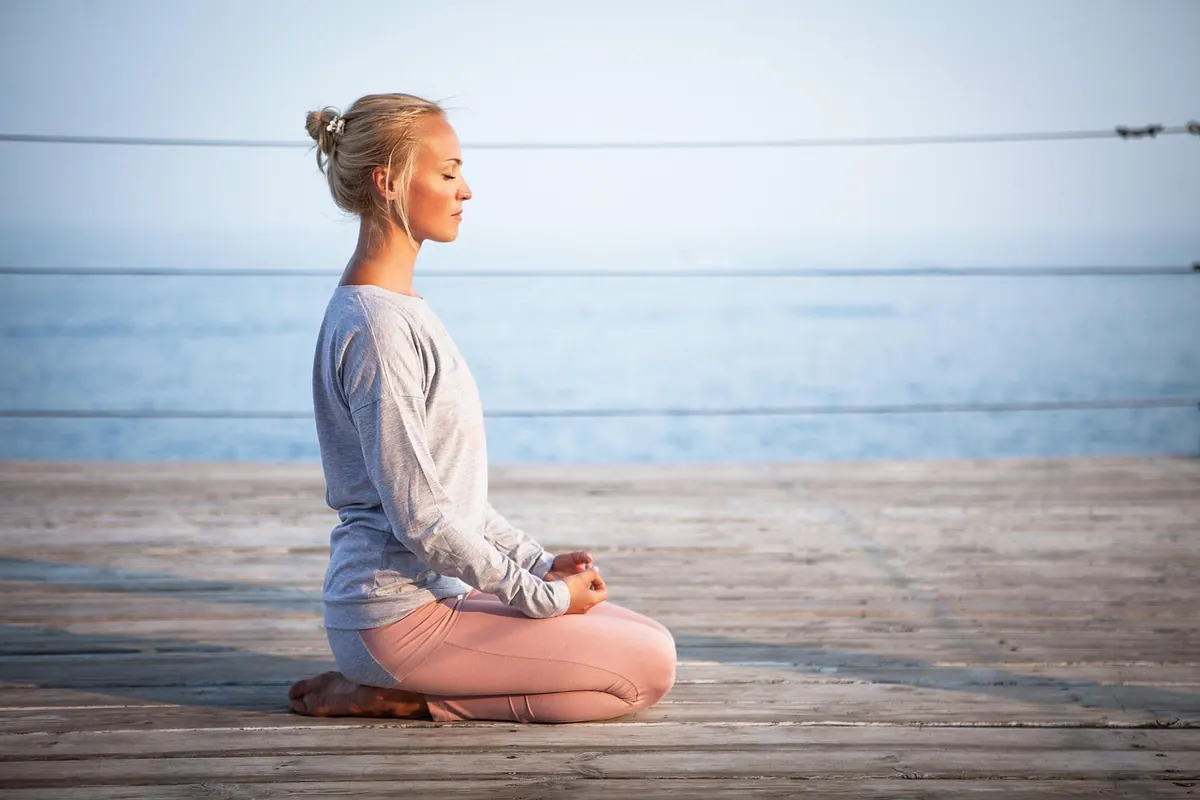
- How you sit. Upright but supported. Feet flat, hands resting in your lap, back against the chair rather than rigidly away from it. Slouching sends you to sleep; perching stiffly makes you fidget. Aim for somewhere in between.
The Five-Minute Breath Practice
- Set a timer for five minutes. Put your phone on aeroplane mode first, otherwise the screen becomes the practice. A gentle chime is fine; a blaring alarm is not.
- Take three easy breaths to arrive. Let each exhale be slightly longer than the inhale. No forcing, no counting yet.
- Let the breath return to normal. Resist the urge to control it. Feel where you notice it most — cool air at the nostrils, ribs widening, the belly rising and falling.
- Count your breaths. Count “one” on the out-breath, “two” on the next, up to five, then start again at one. The counting gives the restless part of your mind a small job to do.
- When you drift, come back. You will drift, often within seconds. Noticing that you have drifted is the practice. Name it lightly — “thinking” — and begin again at one.
- Finish deliberately. When the timer sounds, sit for ten more seconds and notice how you feel. Not to grade yourself, just to register it.
What if I lose count?
Almost everyone does, and it does not matter. Start again at one. The count is a handrail, not a scoreboard. If counting feels fussy, drop it and simply follow the sensation of breathing instead.
If You Really Can't Sit Still
Then do not. The point is attention, not posture. Choose whichever of these makes the practice possible.
- Walk it. Pace slowly round one room, taking roughly one lap per breath.
- Lie down instead. Knees bent, feet flat on the floor. If you fall asleep, that is information about your rest, not your meditation.
- Keep your eyes open. Let your gaze rest softly on a patch of floor. Closed eyes can feel intense for some people.
- Give your hands something. Wrap them round a mug of tea or hold a small stone. A little physical occupation often quiets the rest of you.
- Halve it. Two and a half minutes is still a practice. You can always extend it later.
- Fidget on purpose. If you need to move, move once, deliberately — roll your shoulders, scratch your nose — then return to the breath.
Restlessness usually loosens somewhere around the second or third minute. The first minute is nearly always the hardest. If you stop the moment you want to move, you never find out what sits on the other side of it.
Making It Stick Without Willpower
Keep the same chair and the same time of day for a fortnight. Put a single tally mark on a scrap of paper each time you finish; watching the marks accumulate is quietly motivating and takes no effort at all.
Do not judge the session by how calm it felt. Some five-minute sits will be scattered from start to finish, and those count double, because you stayed. If you miss a day, the rule is simple: no penance, no catching up. The next five minutes are the only ones available to you.
If Breath Practice Feels Uncomfortable
For a minority of people, focusing on the breath stirs up anxiety rather than easing it, particularly those who have experienced panic or trauma. If that sounds familiar, keep your eyes open, shorten the session, and rest your attention on your feet, your hands, or the sounds in the room instead. Come back to the breath when it feels neutral, or leave it be. If breath-focused practice reliably brings distress, it is worth speaking to your GP or a qualified meditation teacher who can adapt the approach with you.
If you have a heart or lung condition, or you are pregnant, check with your doctor before trying forceful breathing, long breath-holds or rapid-breathing techniques. The practice described here is gentle and involves no breath-holding at all.
Your Next Five Minutes
Do it now, before you read anything else. Sit down, set a timer, and count ten breaths. That is the whole thing. Tomorrow, same chair, same time. After a week, if you want more, add two minutes rather than twenty — growth you can actually meet is growth that lasts.
The aim is not to become good at meditating. It is to have somewhere to come back to, five minutes at a time, for the rest of your life.
Photo: Srresume / Pixabay